

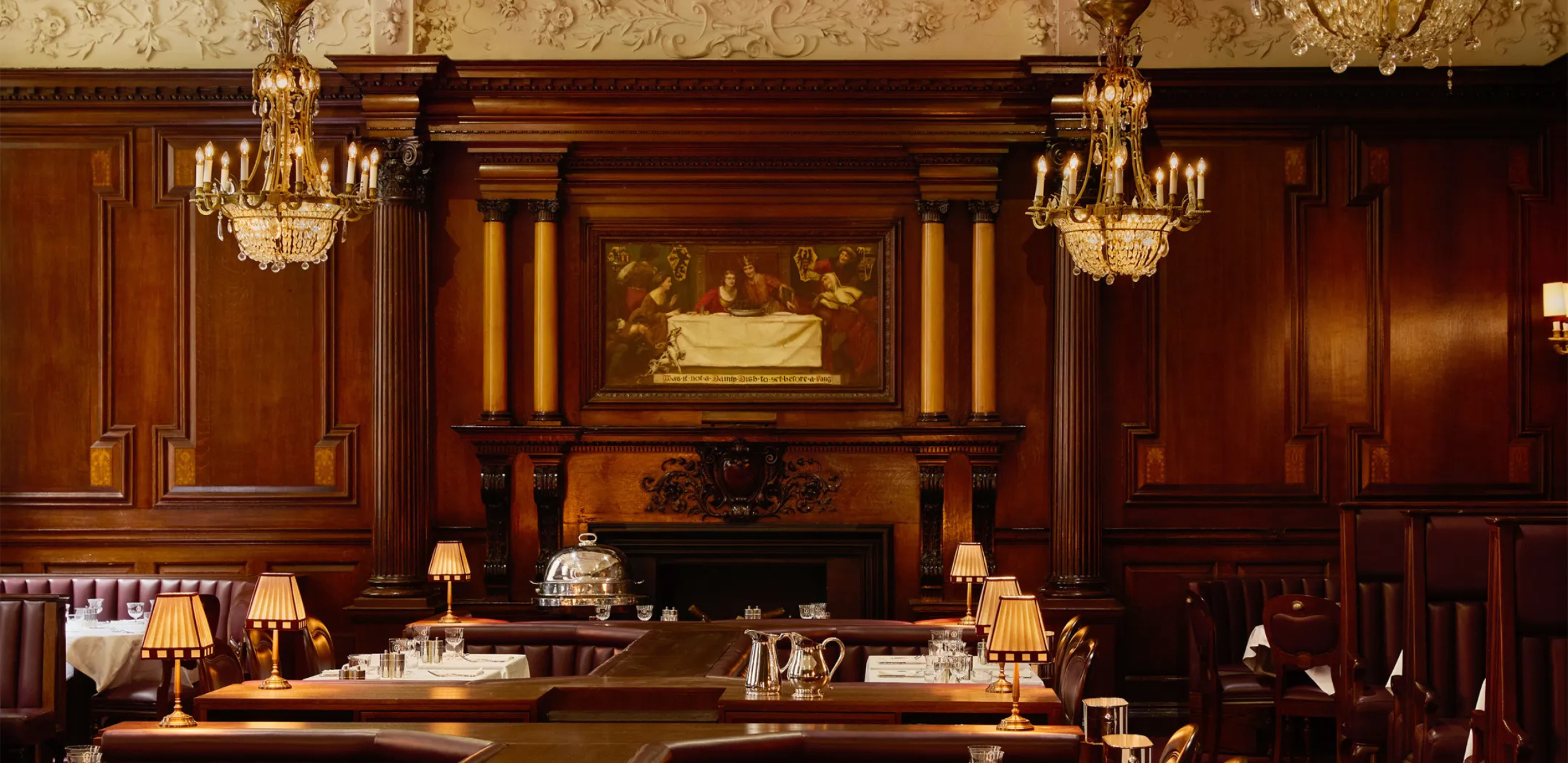

Just over Waterloo Bridge, a silver-domed trolley is moving through a certain Grande Divan dining room once again.
After five years of closure, Simpson’s in the Strand, one of London’s oldest restaurants, has reopened under restaurateur Jeremy King. Founded in 1828 as a coffee house and chess club, the institution built its reputation on traditional English fare and its signature roast beef carved tableside by its Master Carvers.
The revival arrives just short of the restaurant’s bicentenary and after a pursuit that has occupied King for more than two decades. He first attempted to acquire Simpson’s in 2000, again in 2008 and 2015, before finally succeeding in 2022 after the restaurant had remained closed following the pandemic. For King, the appeal was not simply the building itself but what it represents, one of the few surviving landmarks from an earlier era of London dining.
“It’s the last of the grande dame restaurants to retain its original features,” King has said of the project.

At the heart of Simpson’s sits the Grand Divan, an Edwardian dining room long associated with the restaurant’s most traditional form of service.
Provenance is key here. Simpson’s highlights locally sourced ingredients of the highest quality to create roasts, pies, game, vegetable-forward dishes and puddings.
The evening is accompanied by classic cocktails with a twist, an extensive wine list rooted in France and Germany, and rare spirits.
That category, the grand restaurant, is now rare in London.

Simpson’s occupies around 21,500 square feet, containing two restaurants, two bars and a ballroom for private events. The Grand Divan is a 110-seat dining room set beneath Edwardian chandeliers and timber panelling. Upstairs, Romano’s operates as an all-day dining room. Downstairs sits Nellie’s Tavern, a late-night bar named after the opera singer Dame Nellie Melba.
Over the past decade the capital’s restaurant scene has tilted toward smaller chef-led openings and informal neighbourhood restaurants.
King has spent much of his career working in the opposite direction. With his former partner Chris Corbin he created The Ivy, Le Caprice, The Wolseley and Brasserie Zédel.
Step into the Grand Divan and the restoration is restrained. Chandeliers and fireplaces have been refurbished; banquettes remain high-backed and enclosing. Interior designer Shayne Brady, a long-time collaborator of King’s, has said the intention was that the building should feel as though it had been “loved by every owner that has had it”.
“Great design should never shout for attention but should withstand scrutiny,” King says.
The restaurant’s most recognisable ritual has also returned. The silver carving trolley, introduced in the nineteenth century, is again wheeled through the dining room as Master Carvers carve roast beef in front of guests. The tradition dates back to Simpson’s earliest days as a chess club, when food was brought directly to the table so players could continue their games without leaving the board.

The menu remains traditional: pies, savoury puddings, fishcakes and mulligatawny soup sit alongside Devonshire beef and Yorkshire pudding. Breakfast includes the restaurant’s signature “Ten Deadly Sins”, an elaborate full English featuring sausage, bacon, black pudding and bubble and squeak.
The reopening comes at a difficult moment for the industry. According to UKHospitality, roughly one-third of hospitality businesses in Britain are currently operating at a loss, squeezed by rising labour, energy and supply costs.
Against that backdrop, reopening a restaurant of this scale is unusual.
Yet King has long argued that restaurants succeed less through novelty than atmosphere. “There is no formula,” he said in a recent interview with Monocle. “It’s heart and soul.”
The dining room’s lighting is soft. Tables sit within high-backed banquettes that create a sense of privacy. Service moves at a measured pace. Restaurants, King has often observed, become part of people’s personal histories; the setting for first dates, celebrations, negotiations and reconciliations.
Lunch, King says, ought to stretch to nearly two hours. Dinner should take longer still.
That fare, unhurried and formal, once defined London’s great restaurants. Simpson’s reopening suggests the format may not yet have disappeared.
The carving trolley rolls again. And with it, one of the city’s oldest dining traditions.

.png)