

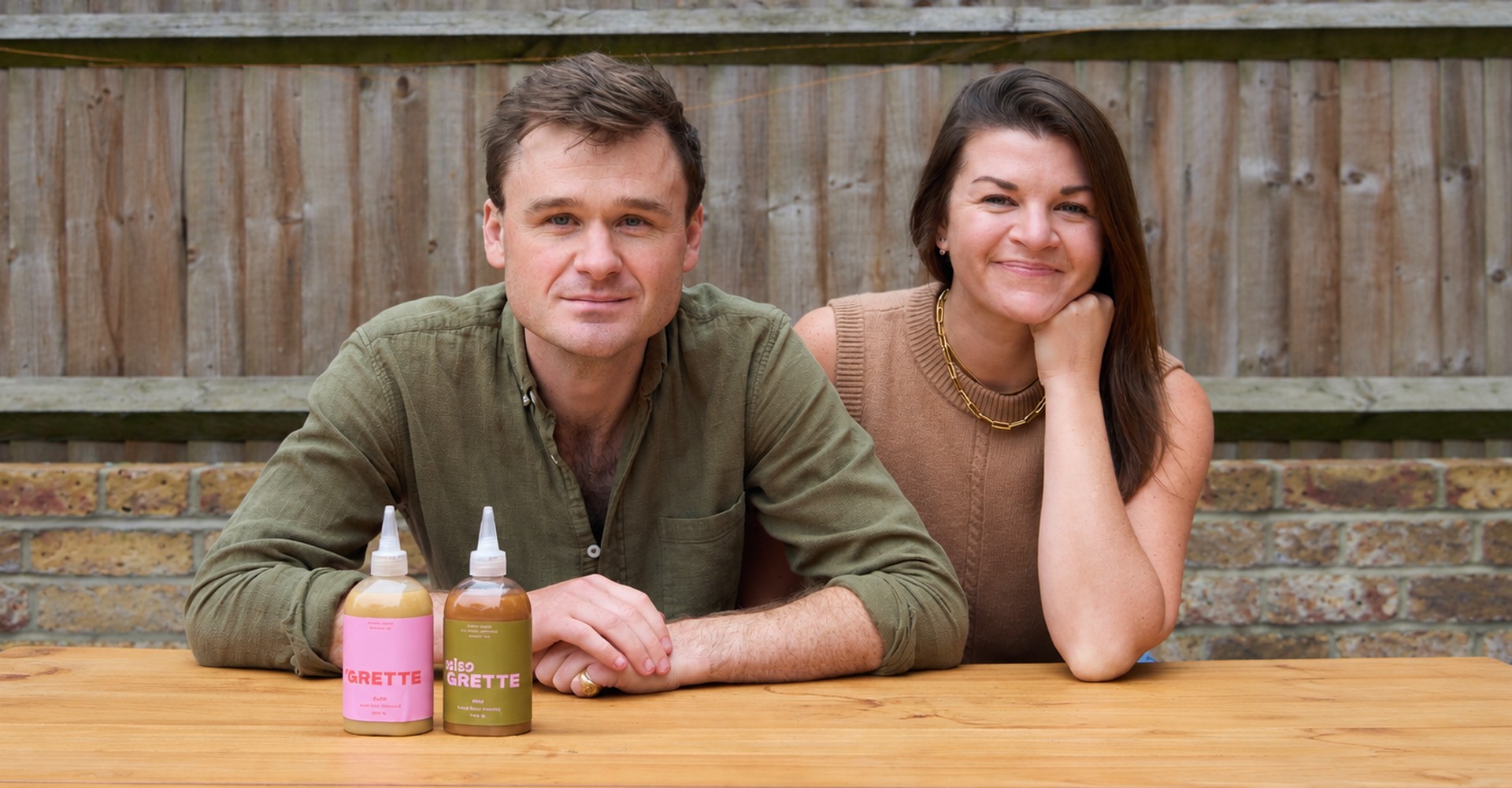

For anyone launching their own CPG product, getting a call from Selfridges two weeks after launch on DELLI is the stuff of dreams. For Gus and Juno Hunter, founders of salad dressing brand ’grette, that’s exactly what happened.
Next time you’re buying groceries, in person or through a screen, take a look at the salad dressings. Then read the labels. Gus and Juno did, and wondered why a mixture of oil and vinegar needed quite so much company. The pricier alternatives had their own conventions: “countryside, grandma”, as Gus puts it. And somewhere among them, within the UK, a pizza chain had become a familiar authority on what to put on your salad.
They made what they wanted at home, using the squeezy bottles they already used for olive oil. The first 11,000 bottles came out of their Stockwell kitchen, fitted around Gus’ work selling wine to London restaurants and Juno’s marketing job at Ticketmaster. Production, mercifully, has since moved elsewhere. The day jobs remain.
After Selfridges, the next ambition might seem obvious. We’ve all seen the LinkedIn posts: a founder, beaming outside a supermarket, announcing that their product is now in Tesco, Sainsbury’s or Waitrose. For ’grette, the aspirations are quite the opposite. At £7.99 a bottle, Gus questions how the dressings would fare beside cheaper supermarket options, and what a listing would mean for the independent retailers already buying them.
Instead, ’grette’s bottles have found their way into shops including Earl of East, Goodhood and Anthropologie. “We have many people that take our product because of how they’re curating their shelves,” Gus says. With exports to Sweden and the Middle East, the brand is finding other routes to growth. We spoke to Gus, with an additional contribution from Juno, about American grocery shelves, the value of good packaging and building a food business without chasing the big grocers.
What did you see in the category that the established dressing brands had overlooked?
It sounds a little cliche to say we made these great recipes at home and friends came round. But the reason we made them at home is because the alternatives were Brianna's or Pizza Express. It's madness that the biggest salad dressing was a pizza chain. We couldn't quite believe there was nothing that just had oil, vinegar and a few other bits. So it was the idea of creating a salad dressing that was clean, that just had the bits you need in it, and could stay shelf-stable because it had the right amount of vinegar. It sounded really obvious to us that it needed to be done, because it was kind of crazy that everything had preservatives in it.
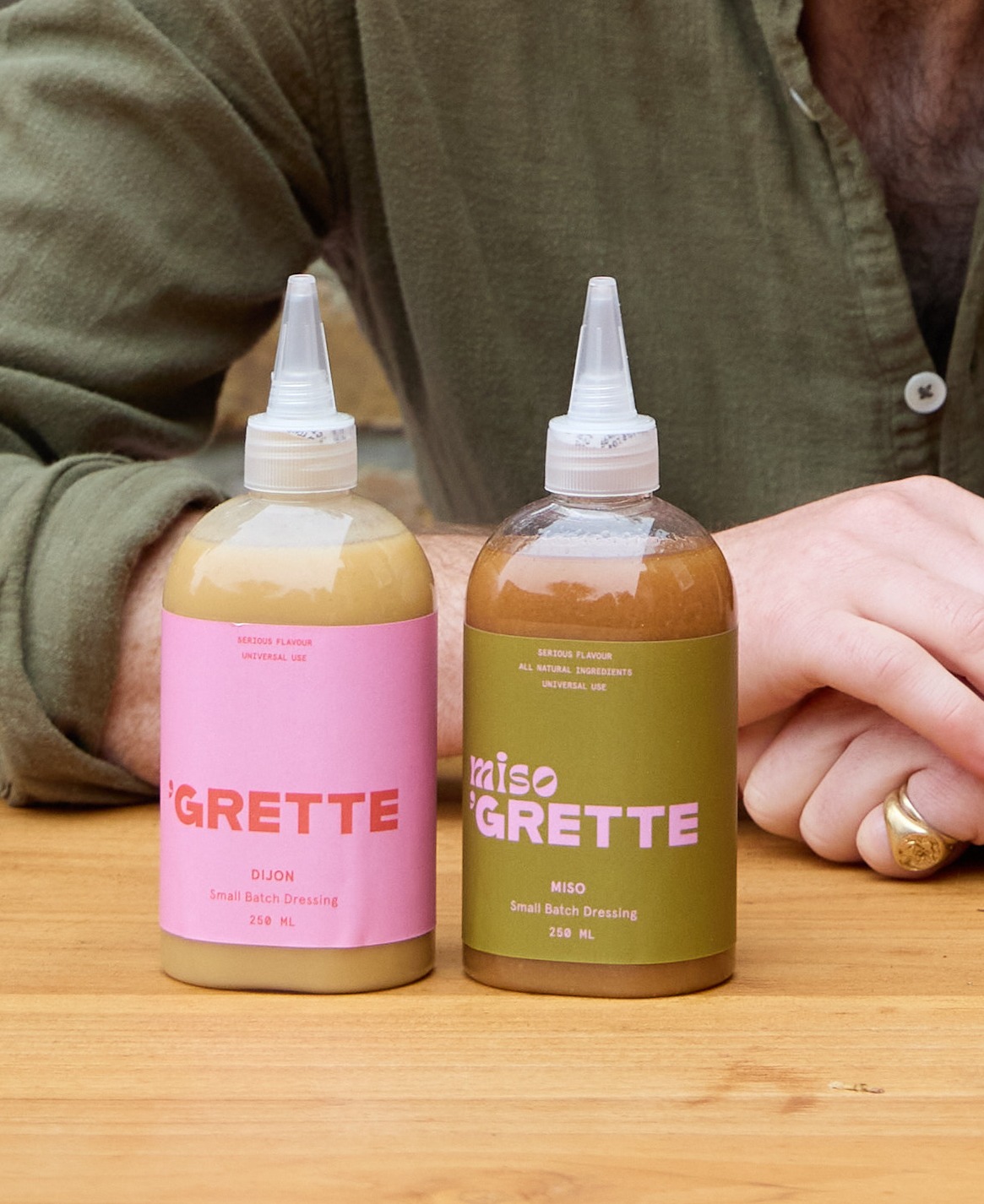
Even the fancy Waitrose ones or the Daylesford organic ones were not that great, and they were all presented in a way that was so twee: countryside, grandma. There was nothing that was cool. So it was, how do we take something with the raw, basic ingredients you need to make a salad dressing that tastes nice, and make it look really cool? The squeezy bottle fell into it naturally, because that's how we serve our olive oil at home - we decant everything into bottles. The whole thing fell into itself, and then we realised: we already have the product. Let's stick it in a bottle and sell it.
I don't want to sound arrogant, but there wasn't a huge amount of thought about it. In the best possible way, we haven't really thought much about how we've done things - we've just done things very organically and at our own pace.
Where did 'grette begin? Had either of you done anything like this before?
Juno and I both have day jobs, full-time jobs. 'grette came about because we live in London, we love living in London, we live in Stockwell and we wanted to continue living there. So we wanted the third income stream - we thought, we need to make some more money, let's do that. Then we got married in June '23, and after the wedding we realised we had all this time on our hands. So it was like, right: we've got the time, we want the money, we think we've got a product. Why don't we start a business?
Juno works at Ticketmaster in marketing, and I sell wine to restaurants. We always wanted to start a food brand. It was always going to be food, because that's something that exists in our lives and brought us together. I'm very fortunate that I get to hang around restaurants every day in my day job - Juno doesn't, although she still has a pretty cool job. So the food brand was the obvious one. I wasn't going to launch an alcohol brand; it's far too complicated.
We launched through DELLI, when DELLI was the original website where you could go online, and I don't know whether we'd be here today if it wasn't for DELLI. The way that we could just send in stock on consignment - they do the marketing, provide the platform and the checkout, so we didn't have to worry about any of that. DELLI in its new form, as an AI platform, is crucial to our business now.
Where did the visual identity come from?
Juno is American, which is sort of relevant. We spent a lot of time in America, and I'm always fascinated when you go to an American grocery store - a fairly average one - and there's all this choice, but it's all very design-led. I guess that was in it for us. And then Kirsten Pincket, who did all our design, is based in America and she's American. She's a very, very good friend - Juno's best friend - and an incredible designer. When we asked her to design it, she was taking inspiration from that US world of seeing food product. So the brand was quite inspired by the US.
You've made a conscious choice not to be in the big UK grocers. Why?
When we retail at £7.99, we're very expensive. In the world of salad dressings, we are the most expensive. I don't think we'd do very well there. We are listed at Booths - Booths is the outlier in that world - but I think we would be on the shelf next to things which are much cheaper, and I wonder whether that would piss off all our independents. So no, we don't want to work with major grocers in the UK.
Export is therefore the answer, and it's a big part of our plan for growth. We already export to Sweden, and it's amazing. Sweden came about when we were at the Golden Fork Awards - Great Taste - for the miso a couple of years ago, and I met someone there who was working with a few other cheese brands and food brands that I really liked. A competition turned into a pallet, a pallet turned into a second pallet, and again - much like everything at 'grette - it happened really organically. We weren't out chasing. The Middle East too: we have a brilliant fulfilment centre that does a lot of the export paperwork for us. The US is definitely a plan for the future, but the US is a whole different tackle.
What's been the biggest surprise about building the business?
Positive: how straightforward it was. We made 11,000 bottles in our kitchen in London while we worked to find our co-packer. You get your food safety certificate, you go to the local council, you apply to be a food premises, and that's all very straightforward. Then you make a product. We launched on DELLI and we were approached by Selfridges two weeks after launching. I know people struggle to get in there, and it's now one of our biggest customers. The straightforwardness of it all - providing the right documentation, getting approved by the council - it just was really straightforward.
Do you think being so design-led is what brought Selfridges calling?
It's no secret that people buy our product without tasting it. The fact it tastes really good is lovely - hopefully a welcome bonus when they get it on their shelves. But we have many people that take our product because of how they're curating their shelves. The design-led aspect leads us to work with lifestyle stores: we work with Earl of East and the Goodhood store in London, and we're in Anthropologie. We are a brand that has crossed into that lifestyle store section, and that is purely because of the design. We can't pretend it's not.
What has customer feedback taught you that you didn't expect?
I remember when we were doing a Selfridges tasting and the first person said it's not very good. I work in wine - I'm used to being told to sling my hook quite regularly. But for Juno, she was quite offended that this was her baby and someone was saying it's not very good. Of course we're desensitised now. But I do remember that first time: these bottles that we handmade in our kitchen have a very emotional attachment to them.
How do you two manage working together?
When you work separately, you never really experience your partner doing what they do best. You overhear calls and stuff, but you never really witness it. What we took from launching 'grette is that in those early days we were producing together - a new skill; we'd never made a salad dressing at scale before. I was out selling it and managing that, Juno was out marketing it, and we got to witness each other doing their thing. It was really amazing, such a rare treat. It was kind of like, oh shit, you're pretty good at what you do. That kept us going, because we were flourishing in our own elements.
As the business has grown, we've taken much harder lines in what roles we take. I manage the production with co-packers, Juno manages the marketing side, and sales is done a little bit between the two of us: I look after the wholesale partners, she looks after the more direct accounts. At the beginning it was a hot mess of everyone working in and checking in together.
You've been deliberate about what not to do yourselves.
The original idea of 'grette was a third income stream, so the business was built to exist outside of our day jobs. We've now reached a point where we have two amazing wholesale partners doing most of the sales - we keep our direct accounts - and we have someone making it for us. The running of the business right now, and I'll be slightly careful how I say this, isn't really a full-time job, because we built it so it doesn't need to be. I think that is the key to longevity in this.
Your tech stack: which two pieces could you not do without?
Juno recently integrated Claude into our Xero and everything. Claude now speaks to our Google Drive and our Xero, and you basically ask one question and get the information. Genius. Then the DELLI platform: in a basic form, it trawls your inbox for orders - we have so many different routes to market - then it generates an invoice on Xero, sends it to Shopify, which sends it to the warehouse, and basically all you do is press approve and it does everything. It will even recognise, right, this wholesaler is on a wholesale price versus a direct customer on a direct price. It's bonkers.
I'm a very old, traditional wine merchant, so Juno has led that. She is our head of tech.
Juno adds: “We use AI throughout our business, from forecasting and inventory management to running most of our day-to-day operations. We’ve also been working closely with DELLI, who are building a platform that lets us manage orders from multiple sources in one place and push them straight through to our warehouse for shipping and to Xero for invoicing. What used to take several clicks, systems and processes now happens in a single place, which has made a real difference to how we work.”
What's in your trolley?
We're all on the bean kick. We all eat Bold Beans - but I would actually say eating Bold Beans has led to eating other beans, because other beans are available. So yeah, I eat lots of different beans. And I'm really into any sort of fancy French mustard, the proper stone-ground stuff. Condiments are kind of my go-to. And Deukes honey, an amazing honey brand I can't believe we're out of. The founder took the family honey and rebranded it completely - honestly, it looks like makeup. Really, really lovely.
But my real guilty secret right now is the M&S vanilla yogurt. I looked at the label last week and saw how much sugar is in it, and one should never consume that for breakfast. So I now ration it. It's really delicious - mostly because it's entirely sugar. Which is why it's so delicious.
Wild card: where do you go to switch off?
It's going to sound really righteous, but exercise for us is key. Since we had Heath, we've doubled down on that - carving out time in our weeks so we each have a chance to go and exercise, go to the sauna, whatever. We can't do two full-time jobs and a side hustle and raise a child without exercising.
Find 'grette at grette.co - there's a clever little map of every stockist.