

.png)

In paid partnership with Tracksuit. Data provided by Tracksuit; editorial control by THE GOODS.
How do you buy olive oil? Is it price point, the brand your mum used to buy, extra virgin, Italy, Greece, Spain, Portugal? I’ve never really suffered from olive oil choice anxiety. My dread has always been whether I should be cooking with it at high heat, whether, as I fry off the guanciale, it will add unnecessary chemical overtones to my Pasta all’Amatriciana.
As consumers, we’ve rewarded the legacy brand’s sameness for decades, their dark glass bottles and stock farm imagery. For the major players, Pompeian, Filippo Berio, Colavita, the category code was consistently dressed as heritage. Nobody disrupted it because the margins were thin, the consumer indifferent, and the product, to most eyes, interchangeable. Or so they thought.
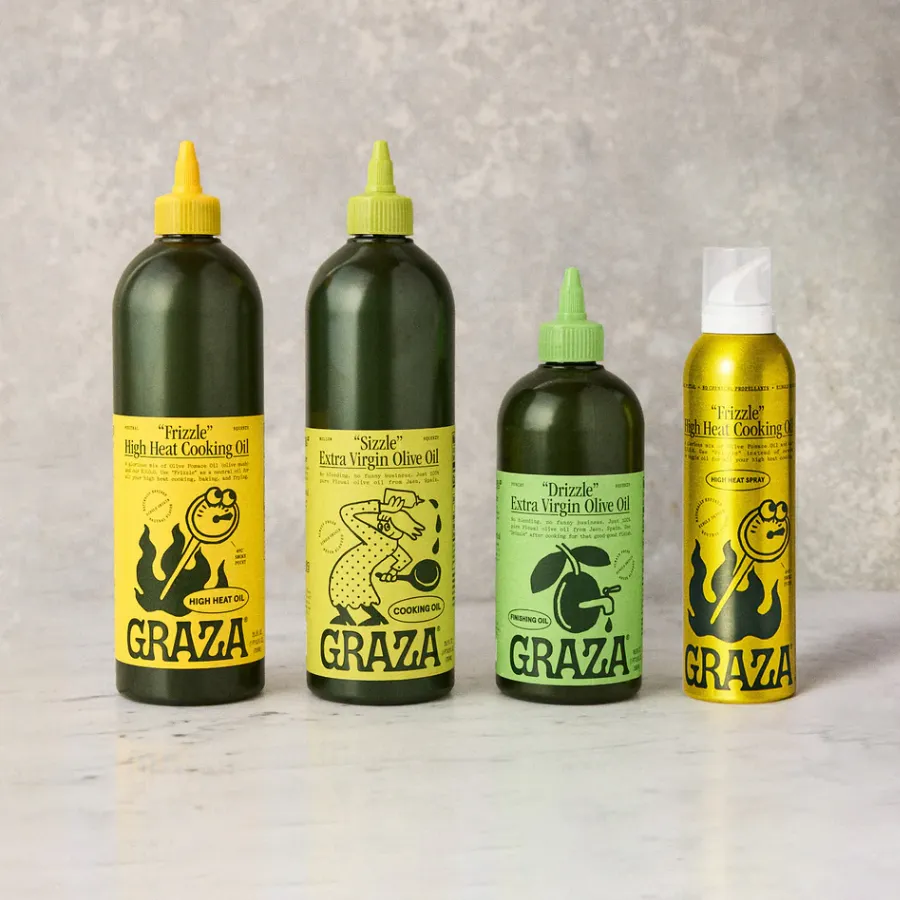
Andrew Benin and Allen Dushi launched Graza in January 2022. They lead with two squeeze bottles and named each for what it did. Sizzle for the pan. Drizzle for the plate. Bon Appétit, which covered the launch, described Graza as a solution for shoppers overwhelmed by the olive oil aisle, noting the squeeze format came directly from professional kitchens, where chefs routinely decant oils into smaller vessels for use on the line. A squeeze over eggs. A glossy line across tomatoes. A loop over soup. A little green flourish on beans; on toast.
They had, in a way, rebooted the act of glugging olive oil into the pan. Graza gave tactile function to the process. And why not? Who doesn’t like a little dance whilst cooking away. Only, with Graza there was less dancing-jeopardy as the oil stood over the pan.
We’ve all been there, a little moving of the hips, emulating Ainsley Harriott’s (iykyk) tilt of the bottle…and there it goes, the glug erupting way too much olive oil in the pan.
Squeeze bottles gave you permission to have that much more fun cooking. It was all about the feeling. And the bottle, the act of squeezing the olive oil into a pan for the Sizzle, or across the salat katzutz for the Drizzle made it all very easy on the eye for socials.
Graza's co-founder Allen Dushi said that the product was designed to be, in his words, "the best supporting actor in any cooking video — every cooking video has that oil-in-the-pan shot at the beginning, and we thought that if we could get this into the right people's hands, even if we couldn't sponsor them, we'd still get that moment."
They sold out online on day one. By year-end, the bottles were on Whole Foods shelves nationwide. Food & Wine reported that Graza cleared $100,000 in its first week, surpassed $4 million in its first year, and crossed $19 million by the end of 2023 — and posed the question that every marketing department tries to decipher for their own product: how much of that was quality, how much was packaging design, and how much was the FOMO of not owning the thing everyone seemed to be posting about.
By mid-2025, Graza was stocked in more than 11,000 retailers, double the prior year, had become the fifth-largest national olive oil brand, and represented 24 percent of total olive oil category growth in the United States that year. Graza was selling a bottle every six seconds and on track to triple its 2024 gross revenue of $48.4 million.
With around 40 employees and offices in New York, Austin and Spain, Graza is now stocked at Whole Foods, Target, Costco and Walmart, a retail footprint that most food brands spend a decade trying to build.
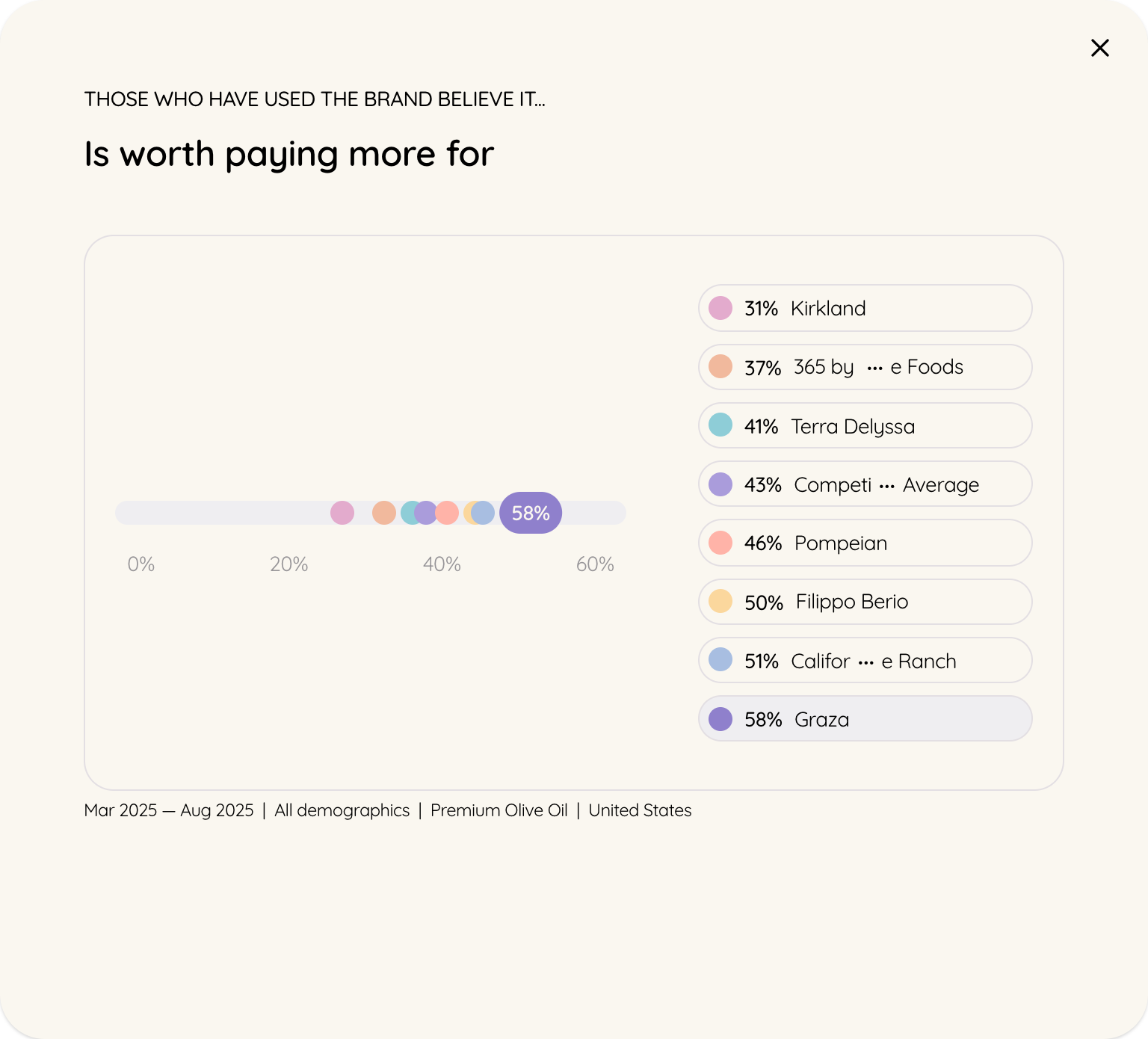
Is Graza’s product the best? Is it priced appropriately? How is it positioned? Who are the first customer buckets to go after? Tracksuit's 2026 brand data makes business sense of the brand’s growth. Among people who have actually used Graza, the brand leads the premium olive oil category on "worth paying more for."
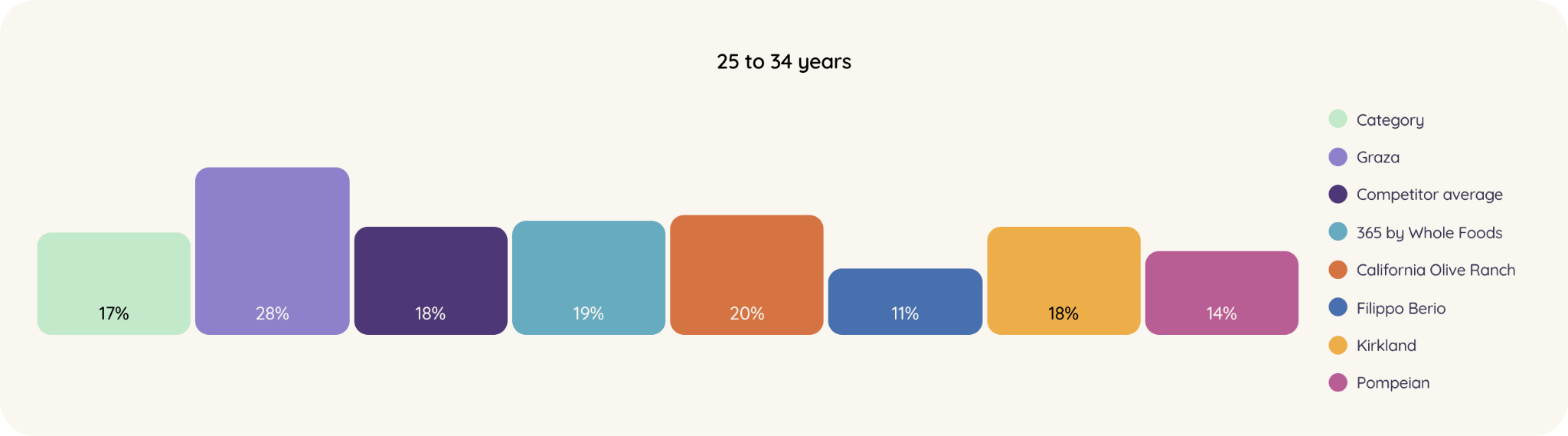
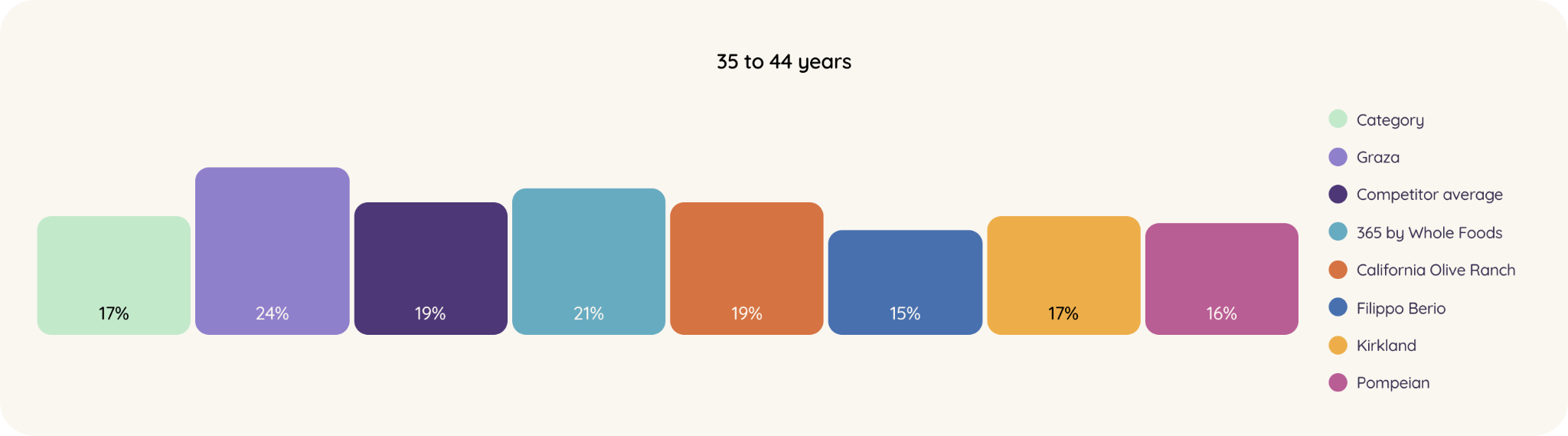
Tracksuit also shows Graza over-indexing on 25-to-34 and 35-to-44-year-olds among people aware of specific premium olive oil brands, more than any competitor in the category. That is the millennial household Graza reached early: food-aware, convenience-literate, and increasingly willing to treat pantry staples as part of self-presentation.
Andrea Hernández of Snaxshot has described this as the “pretty pantry paradigm”, a world in which Millennials signal “down to what we cook with,” and where the visible kitchen ingredient becomes part utility, part taste marker. Graza reached that cohort early, through food creators and design-forward grocery, and the Tracksuit numbers suggest it has kept them through distribution into the brand’s rather swift journey onto mainstream retail shelves.
Five months after launch, Whole Foods stocked Graza. That leg up and Graza’s full metal jacket approach to advertising against them, driving traffic to them, cultivating that partnership at the beginning gave them the foundation to grow. But you can't grow in just one place and one thing that made Graza, Graza early on was about to be challenged.
The squeeze bottle, by 2023, had become its own liability. Once the format was famous enough, it was also simple enough to leverage; to copy. Benin posted on LinkedIn accusing a competitor of imitating the design. The New York Times noted it in its year-end social media roundup.
Hernández, writing in Taste, traced the format's spread across condiments to what she called the "Grazification" of the category. It was a shift that she linked, in part, to the cultural lineage of sriracha, which had already taught a generation of consumers that squeeze bottles felt better in the hand than screw-caps. Her conclusion: "You can't unlearn convenience."
A brand's distinctive assets, its codes of recognition, whether a colour, a shape, a sound or a name are more valuable than most marketers treat them. The instinct to protect or evolve those codes should be resisted far longer than feels comfortable. Yet, the squeeze bottle gave Graza distinctiveness almost instantly.
The harder work, the one at the centre of brand longevity, is building differentiation that survives when the distinctive asset is copied or commodified. That is the project, in part, Kali Shulklapper is now managing.
Shulklapper is Graza's brand marketing director. She graduated from Duke University with a Bachelor of Arts in psychology, pursuing an interdisciplinary track within the university's Department of Psychology and Neuroscience. While at Duke, she focused heavily on media and food studies, serving as a news editor for the university’s newspaper and founding The Dirt, a weekly food culture newsletter.
As I sit down with Kali, Graza is in growth mode. The brand’s clear aim is to become a top-two olive oil company. They’re expanding into other categories and forging partnerships with entities unconventional for your legacy olive oil brands.
What follows is our conversation, with her words reproduced in full.
The squeeze bottle is doing so much work: it's functional, photogenic and viral. As the brand expands into new formats and categories, how do you protect the object's integrity?
"It's funny you ask that, because we are actually not actively trying to protect the squeeze bottle's integrity! The squeeze bottle has become Graza's most recognizable brand asset, and for good reason: It's a functional, innovative format that disrupted a very sleepy category.
But what we are actually trying to do now is communicate who Graza is without the squeeze bottle. And the answer is: We are a product obsessed company that sources and bottles really delicious olive oil, and now makes other delicious products, like mayo & potato chips, with that really delicious olive oil. We don't need the squeeze bottle to communicate that."
In 2026 Graza launched two mayos, an aioli, and a Sizzle spray alongside its largest marketing effort to date. The "Seriously Serious" campaign, created with independent agency nice&frank and directed by Elliott Power of production company Love Song, debuted in March 3, 2026 on streaming platforms including Peacock.
The brief Shulklapper gave to nice&frank was to put quality at the forefront, because Graza's playful voice and packaging had led some consumers to underestimate the oil itself.
"There is this misconception around the brand that because we have such fun packaging and a playful brand voice, we can't possibly produce such high quality oil. So the brief we gave to our friends at nice&frank was to put the quality story at the forefront." - — Kali Shulklapper, LBBOnline, March 2026
"Seriously Serious" comprised three broadcast spots and happens to be one of my personal advertising highlights of 2026. "Spoons," "Testing Twins" and "The Harvest". Each in 30-, 15- and six-second cuts, and each built around the specificity of Graza's product development rather than a general assertion of quality.
"Spoons" features a fictitious employee, Garcia, atop a mountain of 22,353 testing spoons, the number used to perfect the mayo recipe. nice&frank creative director Julian Cohen told LBBO, “They tested over 150 [mayo] formulas over 150 times each. We were like, ‘wow, that's pretty crazy… 150 times 150 is 22,500’. That means they must have used 22,500 spoons to perfect the mayo. So we thought about telling that story in a beautiful, interesting way: What if this tester was sitting on this mountain of spoons?”
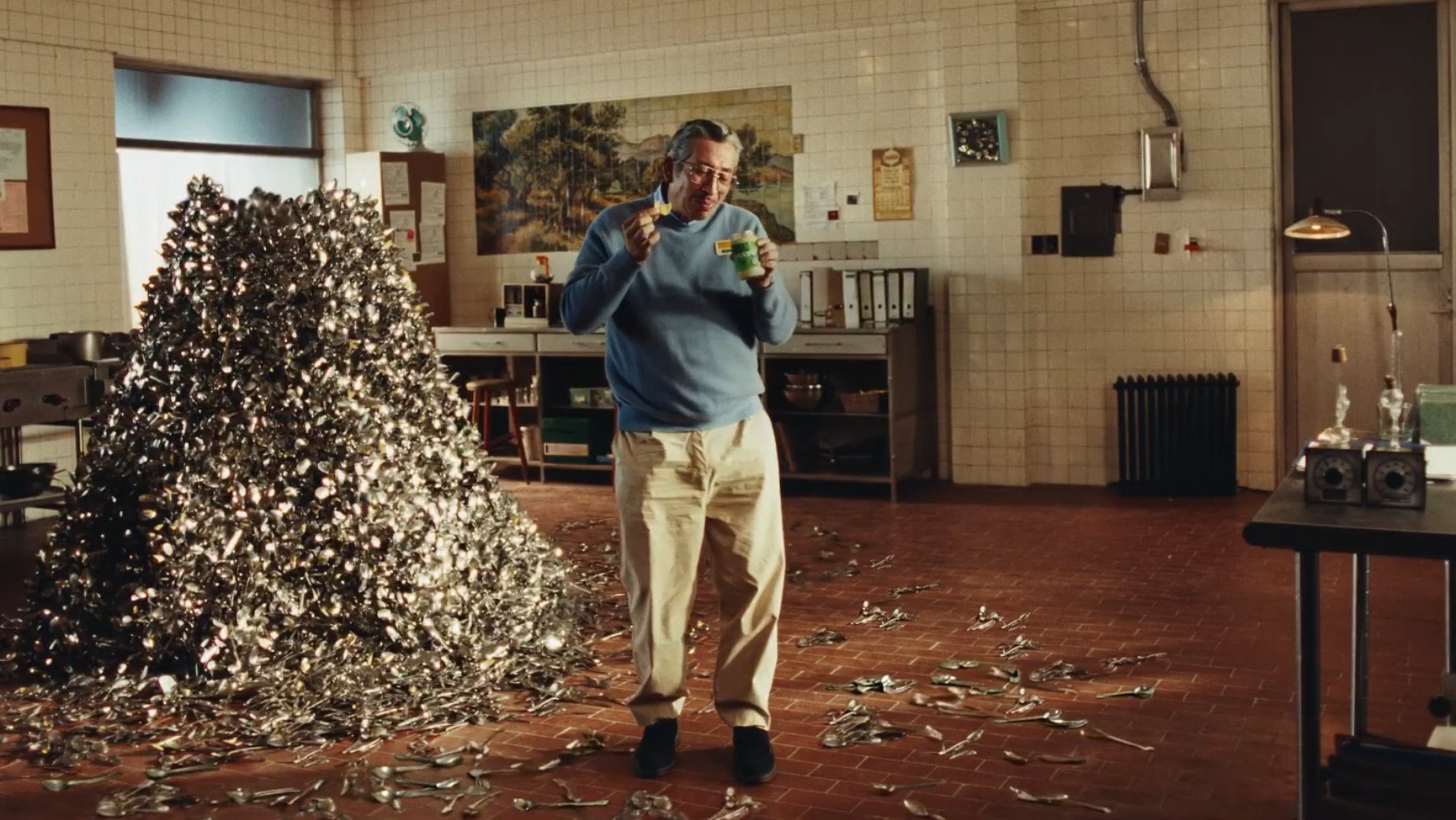
Grace Hwang, creative director at nice&frank, told Muse by Clios the spoons were real; production struggled to source enough near the filming location to build the pile. Elliott Power used deadpan stylisation to turn obsessive condiment testing and lean into Graza’s surreal comedy.
Alongside the TV work, Graza signed as grand prize sponsor for Season 23 of Bravo's Top Chef, beginning March 9, 2026. In February, NASCAR named Graza its official olive oil and mayonnaise partner, with at-track presence and fan programming planned.
What are your biggest priorities in a typical week, and how do you ensure social, PR, partnerships and brand communication move in the same direction?
"Right now, trying to stay afloat! But typically my biggest priorities are overseeing our social and lifecycle channels, alongside brand partnerships and experiential activations. We're currently doing a lot of fun work against our NASCAR and NY Liberty partnerships. It's a small and mighty team and we collaborate on just about everything — this helps ensure that we're all working in sync!"
The NASCAR and New York Liberty partnerships reflect a deliberate audience strategy. Benin told Forbes that the hardest growth problem in consumer brands is not the first wave of customers but the second: "We need to compel people who've never even tasted extra virgin olive oil to buy Graza. It's easier to say, 'You buy extra virgin olive oil, so buy mine,' than to get the next consumer to join the olive oil party."
This is Graza recruiting consumers who were never going to find it through a food creator's kitchen or a Whole Foods olive oil shelf.
You studied Psychology, Neuroscience and Journalism at Duke and your early career was in social strategy and copywriting, not classical brand. How does that wiring show up in how you think about marketing?
"I think marketing is all about communicating and connecting with people. I learned how to write at Duke, and I think that's an insanely underrated skill for marketers.
Every great marketer I've ever met is a really great writer.
As for the 'connecting with people' piece, I can't honestly say that my psych and neuro classes taught me how to do that — I think that just comes from being a person in the world.
That said, I do think that not having a formal marketing or brand strategy background has made me much less beholden to / constrained by certain marketing frameworks or 'rules.' I make a lot of decisions according to my gut and what feels right."
Most brands have to choose between distribution velocity and brand integrity. What's the mechanism that kept those from pulling apart at Graza?
"I feel super lucky to work for a company that values and adequately invests in brand. I know that's extremely rare! At Graza, there is a foundational belief that our brand is our most valuable asset. That the way we make consumers feel — through our voice, our packaging, and our marketing — is incredibly important.
That isn't a belief held by the marketing team alone — it's shared by finance, ops, sales, and every other department.
I genuinely think everyone feels responsible for protecting the brand to some degree, so it never feels like we are fighting to maintain its integrity. Or that it has to be compromised for the sake of performance."
Favourite CPG brands right now?
"Gruns, Goodles, Merit, Fishwife."
What's the hardest feedback you've ever received and how did it affect your current leadership style?
"I am very much a doer, and as I've progressed in my career, I've needed to learn how to do less on my own, and support my team in doing more.
As a perfectionist and a bit of a control freak, you can probably imagine that being quite difficult. But I've received a lot of feedback about the need to delegate more, and I've taken that feedback pretty seriously.
I definitely don't have it all figured out yet, but I'd like to think I've become more of a hands-off manager by really trusting my team to take ownership and accountability, and they do that, because they're the best!"
What's the quality you hire for that never shows up on a résumé?
"Genuine curiosity and being a good person. There are a lot of really smart, talented people I wouldn't want to work with. You've gotta be a good egg."
For CPG founders just getting started, what's the non-negotiable brand marketing move you'd tell them to make heading into 2027?
"I'm not really answering your question, but: 1) Invest in the brand from the beginning. 2) Do things for the fun of it. They don't have to be rooted in strategy — you'll figure it out later. 3) Figure out what you can do better than any other brand in your category."
As GLP-1s reshape appetite, portion size and snacking behaviour, what do you think food brands need to understand about the future consumer?
"I wish I had a better answer for this! Honestly, I think consumer behavior around food will always ebb and flow. Diet and nutrition trends will come and go, but I think consumers will always want food that tastes good and makes them feel good, too."
Last-minute dinner, anywhere in the world, tonight. Where, why and who's already at the table?
"Somewhere in Italy, with my grandparents and Ina Garten. No why needed!"
What did you last treat yourself to, and what are your summer 2026 plans?
"I eat ice cream every single night, so it doesn't really count as a treat... but we can say that it does! And this summer, my partner and I are going to Copenhagen."
Graza’s advantage was never only the object people recognised, but the company behind it. Graza is moving beyond the squeeze bottle, building a brand people actually use, and proving the CPG brand’s bottle was only ever the beginning.
Graza’s next chapter in its time of growth will depend on whether it can carry that same clarity into new products, new retailers, and new audiences without flattening the thing that made it magnetic in the first place. Scale has a way of making brands cautious. Graza’s task is to become bigger without becoming blander.
Because in the end, the bottle was never the point. The point was the behaviour it unlocked, the feeling, the community it created, and the brand conviction required to keep building fearlessly.
Which brings us back to Ina Garten. Garten once said a friend gave her the best business advice she ever received. ‘Employees need two things from you. They need you to be clear, and they need you to be happy.’
It is not a bad brief for Graza, either.
Clear enough that consumers know exactly what to reach for. Happy enough that consumers want to be associated with it, use it, eat it, drink it and leave it out on the side as your arriving guests gravitate to the kitchen, the scent of that Pasta all’Amatriciana blipping away.