


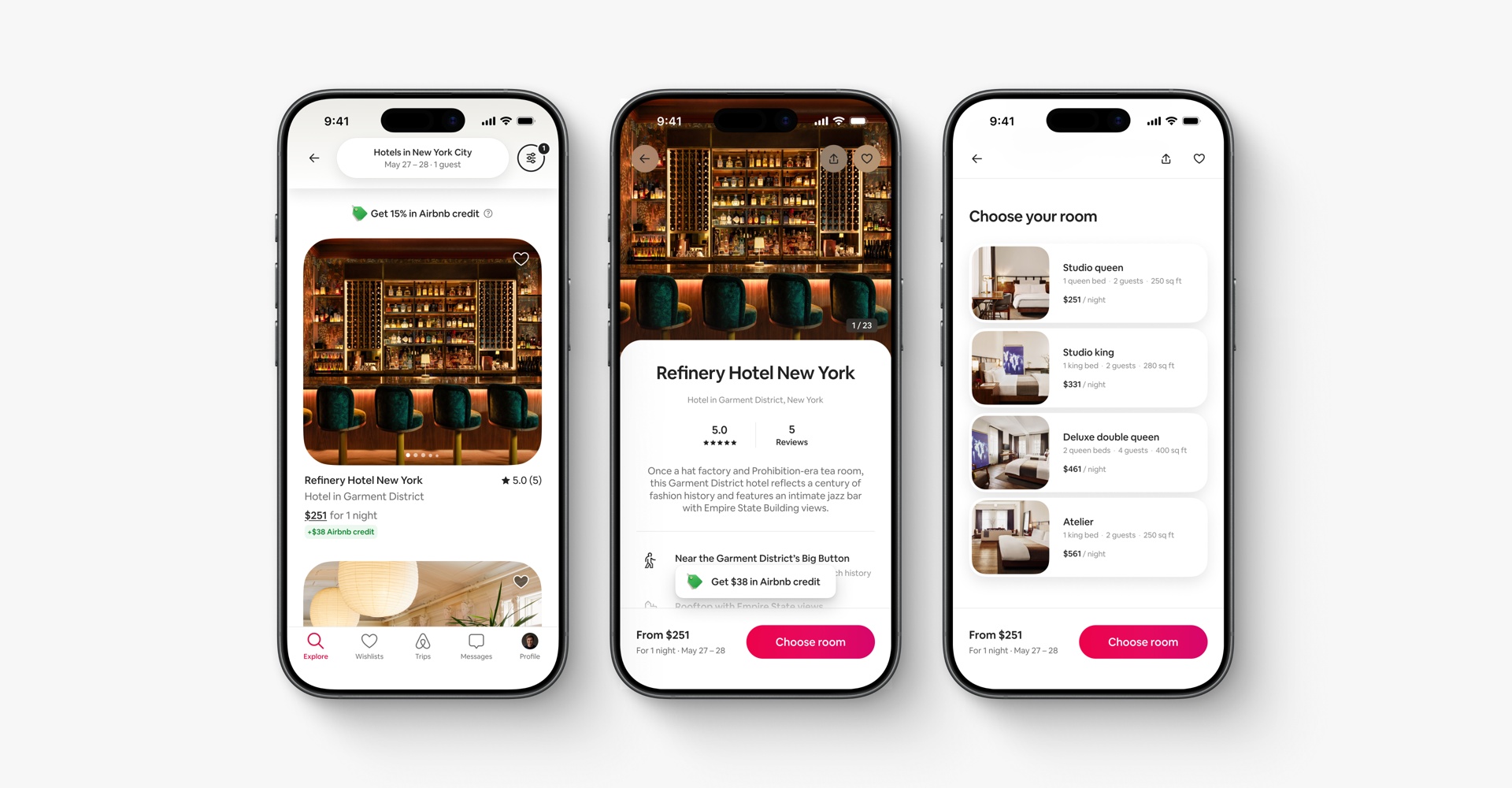

For a company whose first tagline invited people to forget hotels, Airbnb has developed quite an interest in them. Thousands of boutique and independent hotels, in fact, across more than 60 destinations, according to the company. But before hotel owners get too carried away with being wanted, there's the question of who's actually coming through the door. Someone new? Or the same guest, with a different introduction?
Airbnb does reach a different demographic from hotel-focused online travel agencies, according to Professor Peter O'Connor, professor of strategic management at Adelaide University. He expects that difference to be particularly useful for smaller hotels outside the major chains, whose difficulty is often getting in front of potential guests in the first place.
He tells the goods: "The key issue in hotel distribution is visibility, and this move will put their rooms in front of an audience that they otherwise would find very hard to reach."
His assessment is broadly positive: another established platform could help hotels reach customers and reduce their reliance on existing intermediaries. But he cautions that proving where a booking would otherwise have gone is difficult. Travellers compare rates across sites, including through Google Hotels and Kayak, so a booking recorded as coming from Airbnb is not necessarily new business for the hotel.
Airbnb makes the case that the visibility is additional. Andrea D’Amico, the company’s vice president of hotels, told CoStar: “We are giving hotels that are working with us visibility that I would say is largely incremental.” He added: “Ninety percent of Airbnb customers come directly to us. They don’t come through digital marketing activities.”
Lou Zameryka, Airbnb’s global head of hotel enterprise and connectivity partnerships, said on a Phocuswright conference panel on 18 November that Airbnb is already competitive on margin for hotels and launched with an incentive structure that aligns Airbnb’s success with the hotel’s. On The Modern Hotelier podcast, he described Airbnb as design-centric and experience-centric, with hotel descriptions that open on what makes a property unique rather than how far it is from the subway.
Why another channel matters
Hotels have reason to consider an alternative. A HOTREC study published in September found that Booking Holdings and Expedia Group together handled 85.4% of European hotel bookings made through online travel agencies in 2025.
That figure describes the agency market, not all hotel reservations. In the same study, based on information from 2,713 hotels, 29.9% of bookings came through online travel agencies and 51.3% were made directly with hotels. The concern is how few companies account for most of the business within that intermediary channel.
The tension is also playing out in court. On 30 October, HOTREC announced that 18,135 hotels were participating in a collective action against Booking Holdings before the Amsterdam District Court. They allege harm from historic price-parity clauses, which restricted their ability to offer better terms elsewhere. A first hearing is expected in 2027.
Booking.com disputes the claims, saying its past clauses did not breach competition law or cause losses. It no longer uses them in the European Economic Area. The claims remain contested; the number of hotels taking part is not a finding that damages are due.
Separately, the European Commission's September update explains that the Digital Markets Act prevents Booking.com from restricting hotels' freedom to offer different prices, availability or terms on other channels. Hotels have more scope to decide how to sell their rooms. A new platform gives them another place to exercise that choice.
What Airbnb gains
Airbnb's expansion is not a response to financial distress. In its third-quarter results, the company reported revenue of $4.9 billion, up 19% year on year, and net income of $1.9 billion. It also authorised a further $12 billion in share repurchases.
Hotels can help it keep customers whose next trip does not suit a home rental. In Hotel Dive's reporting, Airbnb's hotels vice-president Andrea D'Amico describes travellers going elsewhere when homes are scarce, tightly regulated or less suitable for their stay. Last-minute bookings and short visits are among the opportunities.
New York shows why supply matters. The city's short-term rental rules generally prohibit whole-home rentals for fewer than 30 days. Legal short stays require the host to remain in the unit, with no more than two guests, excluding children under four. Local Law 18 added registration requirements to existing restrictions.
According to AirDNA's November analysis, hotels accounted for roughly one in four Airbnb reviews in New York over the preceding year, compared with about 2.7% worldwide. Reviews are not bookings, and the comparison does not establish that regulation caused the hotel expansion. It does show how prominent hotel stays can become on Airbnb in a constrained market.
The company's own figures reveal another incentive. Approximately 35% of guests whose first Airbnb booking was a hotel returned to book a home within a year. This was a historical cohort who booked hotels between October 2024 and September 2025, not a forecast for every new guest. It nevertheless suggests that hotels can introduce customers to Airbnb's larger homes business.
The reciprocal benefit is less clear. A hotel guest who later rents a home helps Airbnb, but that does not demonstrate that the hotel gained a booking it would otherwise have missed.
The cost of winning a guest
O'Connor argues that hotel owners should look beyond the most visible cost: the platform's commission. A direct booking avoids that charge, but attracting the guest can still be expensive.
He says: "However, my research has shown that many hotels spend more per booking trying to attract direct bookings."
He points to inefficient marketing and hotel websites that convert too few visitors into customers. His argument is not that direct bookings are undesirable. It is that their acquisition costs need to be counted alongside the commissions paid to intermediaries.
Cancellations also affect the value of a booking. Hotel-software company Cloudbeds' 2026 report, based on 90 million bookings across 180 countries, recorded a 21.8% cancellation rate for online travel agency bookings in 2025, compared with 10.6% for direct bookings. That is a different dataset from HOTREC's European survey, and it does not isolate Airbnb's performance.
For an individual hotel, the useful evidence would be completed stays, the total cost of acquiring them and whether those customers represent additional demand. Neither Airbnb's hotel-to-home conversion figure nor the wider industry's booking shares answers that question.
O'Connor still sees a benefit in a wider choice of distributors:
He says: "This will add another major player, with a well-established customer base that differs significantly from the OTAs, so it will be a positive development for hotels wishing to diversify their risk."
Image courtesy of Airbnb